
Lynred - Restoring Infrared Imagery
Published:
A high-performance pipeline designed to detect and restore heavily degraded vertical column defects.
It is engineered during my R&D internship with LYNRED for raw 16-bit infrared image sequences across VGA, SXGA, and HD sensors.
Our solution achieved the top one comprehensive performance among all participating teams, outperforming peers in both strict quantitative benchmarks and qualitative visual fidelity.
Defective Columns Restoration
In infrared imaging systems, read-out integrated circuit (ROIC) anomalies (such as operational amplifier sensitivity drift) frequently introduce severe vertical stripe defects. These manifest as three primary distinct typologies:
- Noisy columns: Constant high temporal noise compared to the background.
- Blinking columns: Sudden high/low-frequency digital level shifts over time.
- Fragmented blinking columns: Rapid spatiotemporal structural breaks where defects randomly appear or vanish within a single column frame-by-frame.
Our objective was to optimize a dual-metric final score balancing localization accuracy (\(\text{F1-Score}\)) and restoration fidelity (\(\text{RMSE}\)).
🛠️ System Architecture & Methodology
Instead of relying purely on deep learning or simple traditional interpolation, we designed a hybrid framework combining Advanced Statistical Anomaly Detection and Localized Edge-Preserving Variational Filtering.
1. Defect Detection Engine
We developed and benchmarked five independent localization approaches:
- Baseline Statistical Detectors: Difference-in-Median filtering and Temporal Standard Deviation mapping (\(\text{F1} \approx 0.50\)).
- Unsupervised Anomaly Detection: Isolation Forests using engineered statistical descriptors (Temporal Mean, Spatial Variance, Differential Context).
- Deep Learning (2D Asymmetric CNN): To tackle highly non-linear fragmented blinking, we built a 2D CNN with an elongated vertical receptive path (\(7 \times 3\) and \(5 \times 3\) asymmetric kernels) to prevent horizontal cross-talk. Coupled with multi-scale morphological area constraints, it achieved a peak aggregate \(\text{F1}\)-score of 0.89.
- Final Production Layer (Local Mean of Medians): A robust uniform-filtered column median comparison algorithm. It achieved the highest comprehensive system stability across multi-resolution data sensors.
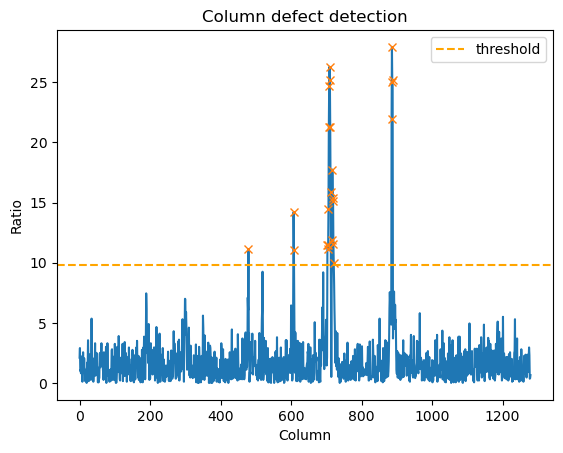
🔍 Figure 1: Adaptive statistical threshold alignment via Detector 5 (Local Mean of Medians).
2. Signal Decomposition & Correction Pipeline
We formulated the restoration task strictly as a signal decomposition problem rather than blind pixel replacement: \(X_{\text{corrected}} = X_{\text{raw}} - S\)
Where \(S\) isolates the additive vertical stripe noise component. This math guarantee ensures that healthy pixels remain absolutely untouched.
The core correction execution follows a 4-stage 1D pipeline applied independently to each corrupt column:
- Guided Reference Estimation: Distance-weighted spatial interpolation from the nearest \(n=3\) clean columns.
- 1D Side-Window Filtering (SWF): Sub-window boundary checking (\(r=8\)) to prevent blurring physical scene edges.
- High-Frequency Isolation: Separating fine texture and stripe patterns.
- 1D Gradient Domain Guided Image Filter (GDGIF): Minimizing a local linear optimization model with edge-perception regularization (\(\mu = 0.022\)).
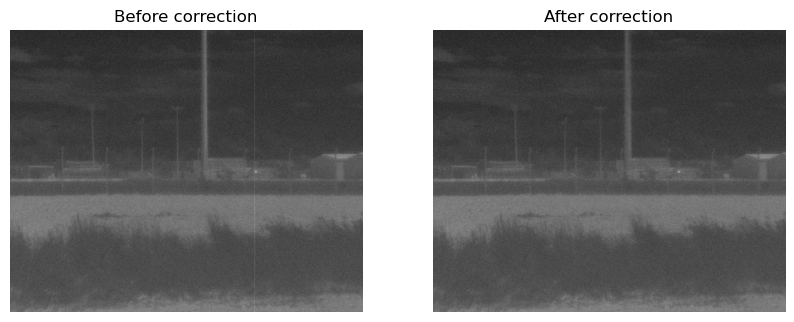
✨ Figure 2: Visual verification of the final pipeline output. Sharp horizontal textures and faint background objects are perfectly preserved with zero smearing.
📊 Performance & Experimental Results
The combined Local Mean of Medians + Side-Window GDGIF architecture achieved an outstanding average final score of 0.75 on the multi-sensor challenge dataset.
Comprehensive Visual Residual Evaluation
To thoroughly assess artifact injection, ringing, and edge-degradation, we mapped the absolute pixel-wise error residuals (\(|X_{\text{corrected}} - GroundTruth|\)) across all candidate approaches.
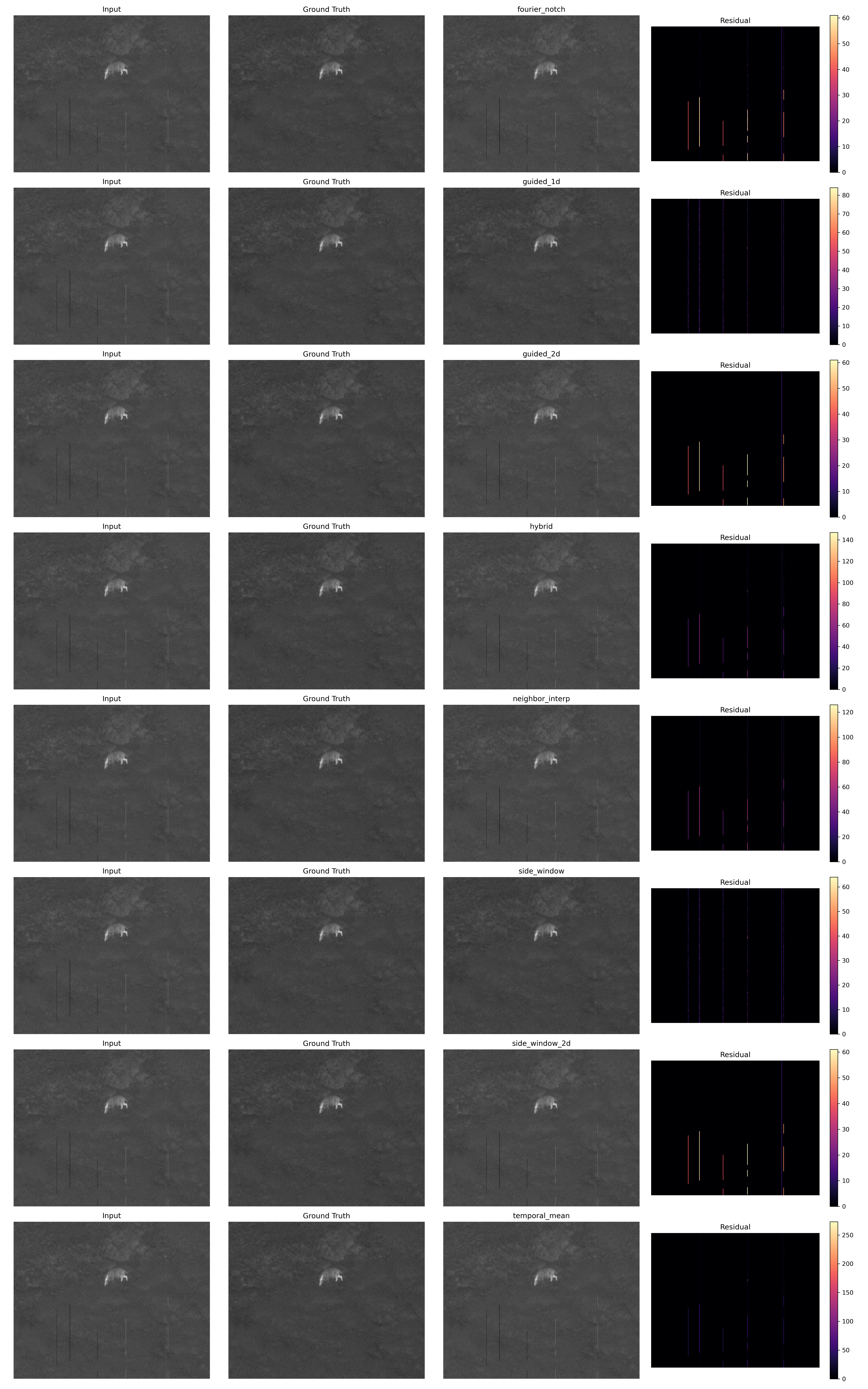
📊 Figure 3: Comprehensive residual diagnostics map across all tested recovery methods. Lower and cleaner residual bounds indicate superior correction fidelity without introducing structural ghosting.
Quantitative Comparison of Correction Models
| Correction Method | Evaluation Score | Peak Absolute Residual | Key Operational Limitation |
|---|---|---|---|
| Side-Window 1D GDGIF | 0.7035 | ~40 LSB | (Selected) Optimal edge preservation |
| Guided 1D Filter | 0.6733 | ~80 LSB | Slightly weaker edge preservation than SWF |
| Fourier Notch Filtering | 0.4779 | ~60 LSB | Gibbs ringing artifacts; fails on non-periodic blinking |
| 2D Spatial Guided Filter | 0.4384 | ~60 LSB | Vertical incoherence from pixel-wise guide construction |
| Neighbor Interpolation | 0.4601 | ~100 LSB | Blind low-pass behavior smears diagonal scene structures |
| Temporal Mean Averaging | 0.1974 | ~250 LSB | Severe ghosting artifacts under dynamic camera motion |
💡 Key Takeaways & Engineering Insights
- 1D vs. 2D Constraints: Attempting 2D spatial patch corrections (
guided_2d,side_window_2d) introduced severe vertical incoherence because horizontal image structures leaked into the vertical linear models. Reverting to an explicit 1D column-wise tracking solved this fundamentally. - Edge Preservation: Traditional spatial filters acting as blind low-pass smoothers always smear sharp boundaries. By implementing the Side-Window constraint, the filter gracefully handles high-contrast intersections without introducing ringing or artifacts.
- Edge Deployment Ready: The entire inference pipeline operates on local 1D data vectors, entirely bypassing heavy global matrix operations—making it exceptionally suited for embedded edge infrared sensors or real-time low-latency systems.
Check out the comprehensive codebase and implementation artifacts on our GitHub Repository.
Details in the report.